5 Ways Leadership Gaps Cost Nigerian SMEs Millions Annually
Published by Efficientra | 8-minute read
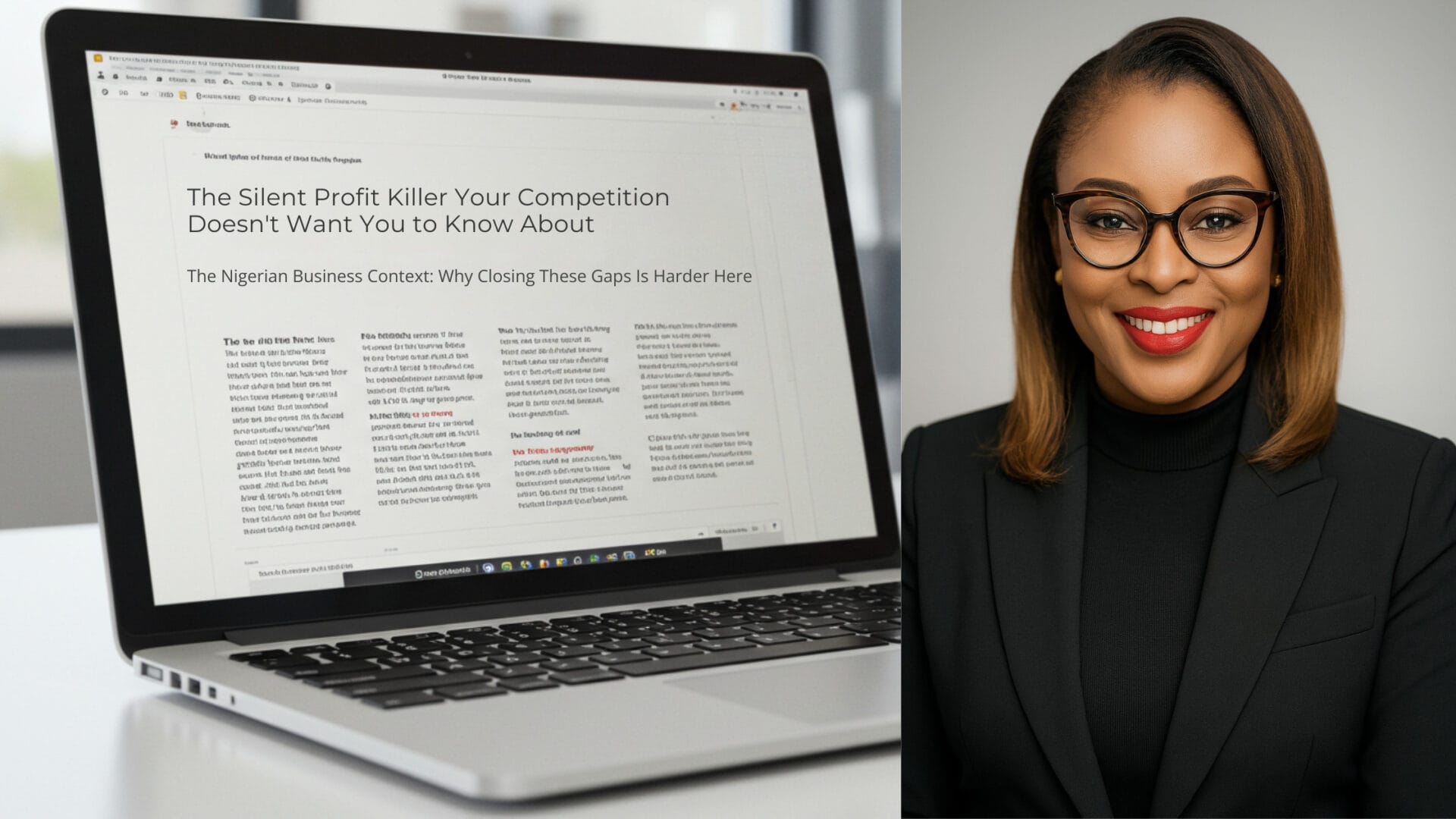
The Silent Profit Killer Your Competition Doesn’t Want You to Know About
Last month, I sat across from Adebayo, the CEO of a thriving Lagos-based packaging manufacturing company with 150 employees and ₦800M annual revenue. Despite impressive growth numbers, he was frustrated. “We’re hitting our targets,” he said, “but everything feels harder than it should be. My leadership team seems to be pulling in different directions.”
Three months later, after implementing our “Leadership Gap Framework”, his company reduced operational inefficiencies by 31% and increased employee retention by 45%. The financial impact? An additional ₦8.2M in profit, money that was previously bleeding out through the cracks of leadership gaps.
Adebayo’s story isn’t unique. Across Nigeria, SMEs are unknowingly hemorrhaging millions due to leadership gaps, a silent destroyer that most CEOs never see coming.
Our analysis of numerous Nigerian SME clients reveals five distinct ways that leadership gaps cost companies millions annually. For a typical Nigerian SME with ₦500M annual revenue, these inefficiencies can translate to massive profit losses, money that’s bleeding out while you focus on growth strategies and market expansion.
Way #1: Lost Productivity (Up to 23% Efficiency Decrease)
The Problem
When your leadership team has gaps in coordination, employees receive conflicting priorities, unclear direction, and mixed messages about what’s actually important. This creates a cascade of inefficiency throughout your organization.
What It Looks Like in Nigerian SMEs
At a fintech startup in Lagos, the CMO prioritized customer acquisition while the COO focused on product development. The result? The sales team was promising features that didn’t exist, while the tech team built solutions nobody was selling. Productivity dropped 20% as teams constantly reworked projects and attended meetings to “get clarity.”
The Real Cost
- Rework and corrections: Teams spend 15-25% of their time fixing work that should have been done right the first time
- Meeting overload: Misaligned leadership creates 40% more meetings as teams seek clarity
- Resource waste: Conflicting priorities lead to duplicated efforts and abandoned projects
For a ₦500M company: A 23% productivity loss translates to approximately ₦115M in lost operational efficiency annually.
Way #2: Talent Turnover (67% Higher Turnover in Key Positions)
The Problem
Nigeria’s best employees have options. When they sense leadership confusion, conflicting directions, or constant strategic pivots, they leave for competitors or international opportunities.
What It Looks Like in Nigerian SMEs
A manufacturing company in Kano lost three senior managers in six months. Each cited “unclear direction” and “constant changes in priorities” as reasons for leaving. The real issue? The leadership team had fundamentally different visions for the company’s future but never addressed these differences openly.
The Real Cost
- Replacement costs: Recruiting and training a senior manager in Lagos now averages ₦3.2M
- Knowledge loss: Departing employees take institutional knowledge, relationships, and processes with them
- Productivity gaps: New hires take 3-6 months to reach full productivity
- Team morale: High turnover in leadership positions creates uncertainty throughout the organization.
For a ₦500M company: Losing just 3 senior managers annually costs ₦9.6M in direct replacement costs, plus productivity losses.
Way #3: Delayed Decision-Making (40% Longer Project Completion)
The Problem
When leadership has gaps in their decision-making process, decisions get delayed, revisited, or implemented half-heartedly. This creates a bottleneck that slows down everything from product launches to operational improvements.
What It Looks Like in Nigerian SMEs
An oil services company in Port Harcourt spent eight months trying to decide on a new project management system. The CEO wanted cost-effectiveness, the Operations Director wanted functionality, and the IT Manager wanted security. Without alignment, they cycled through vendor presentations, endless discussions, and postponed decisions. Meanwhile, projects continued to run over budget and behind schedule.
The Real Cost
- Opportunity costs: Delayed decisions mean missed market opportunities and competitive advantages
- Project overruns: Longer timelines increase labor costs and resource consumption
- Customer impact: Delayed deliveries damage relationships and result in contract penalties
- Market position: Slow decision-making allows competitors to capture market share
For a ₦500M company: A 40% delay in key projects can cost ₦50-80M annually in missed opportunities and overruns.
Way #4: Failed Strategic Initiatives (52% Failure Rate)
The Problem
When leadership teams have gaps in strategic direction, initiatives fail not because they’re bad ideas, but because they lack coordinated execution and commitment.
What It Looks Like in Nigerian SMEs
A retail chain in Abuja launched a digital transformation initiative. The CEO championed it, but the Operations Manager quietly resisted because he wasn’t consulted on the strategy. The IT Director focused on technical implementation while the Sales Director ignored the new processes. Result? ₦15M invested with minimal results, and the initiative was quietly abandoned.
The Real Cost
- Wasted investments: Failed initiatives drain resources with no return
- Demoralized teams: Repeated failures create cynicism about future changes
- Competitive disadvantage: While you’re failing to execute, competitors are moving ahead
- Reputation damage: Failed initiatives can damage credibility with investors, partners, and customers
For a ₦500M company: A major failed initiative can cost ₦10-25M in direct investment, plus opportunity costs.
Way #5: Customer Service Issues (28% Increase in Service Problems)
The Problem
Leadership gaps create inconsistent customer experiences as different departments pursue conflicting priorities or interpret company values differently.
What It Looks Like in Nigerian SMEs
At a logistics company in Lagos, the Sales Director promised 24-hour delivery to win contracts, while the Operations Director implemented cost-cutting measures that made this impossible. Customer complaints increased 35%, and the company lost two major clients worth ₦45M annually.
The Real Cost
- Customer churn: Inconsistent service drives customers to competitors
- Reputation damage: Poor service experiences spread quickly in Nigeria’s relationship-based business culture
- Increased service costs: Fixing problems costs 5-10 times more than preventing them
- Lost referrals: Satisfied customers refer others; dissatisfied customers warn others away
For a ₦500M company: A 28% increase in service issues can cost ₦30-60M annually in lost customers and remediation costs.
The Compound Effect: When All 5 Ways Hit Simultaneously
Most Nigerian SMEs don’t experience just one of these problems, they experience multiple issues simultaneously, creating a compound effect that can devastate profitability:
Real Example: A technology company in Lagos experienced:
- 20% productivity loss (₦40M impact)
- Loss of 2 key managers (₦8M replacement costs)
- 6-month delay on major product launch (₦25M opportunity cost)
- Failed expansion initiative (₦12M wasted investment)
- 15% increase in customer complaints (₦18M in lost business)
Total Annual Impact: ₦103M in losses over 20% of their annual revenue.
The Nigerian Business Context: Why Closing These Gaps Is Harder Here
Leadership gaps in Nigerian companies have unique characteristics shaped by our business culture:
- The “Yes Sir” Syndrome
Respect for hierarchy creates environments where leaders agree publicly but pursue different agendas privately. This cultural politeness masks fundamental disagreements about priorities and direction.
- Family Business Dynamics
Many Nigerian SMEs evolved from family businesses or maintain family-style relationships. While this creates loyalty, it makes difficult conversations about performance and direction nearly impossible.
- Generational Leadership Gaps
Older leaders often prioritize relationship-building and consensus, while younger executives push for rapid digital transformation and data-driven decisions. Without proper gap closure, these approaches create internal friction.
The Solution: Strategic Leadership Gap Closure
The good news? Leadership gaps are entirely preventable and fixable. At Efficentra, we’ve developed a proven framework specifically for Nigerian SMEs that addresses these cultural dynamics while driving measurable business results.
The Five Critical Areas to Close Leadership Gaps
- Vision Clarity and Cultural Integration Your leadership team must understand not just what you’re building, but how it fits within Nigerian market realities and cultural expectations.
- Resource Allocation Consensus In resource-constrained environments, leadership must bridge gaps in priority allocation of money, people, and time.
- Communication Protocols Balance traditional Nigerian business courtesy with the directness required for effective decision-making.
- Performance Standards and Accountability Clear agreement on what success looks like and who’s responsible for outcomes – closing accountability gaps.
- Risk Management and Growth Strategy Bridge gaps in growth strategy while managing Nigeria-specific risks.
Real Results from Nigerian Companies
Manufacturing Company, Lagos: Reduced decision-making time by 60%, increased operational efficiency by 31%, achieved ₦8.2M additional profit in year one.
Fintech Startup, Abuja: Aligned leadership on customer acquisition strategy, resulting in 150% increase in qualified leads and successful Series A funding.
Oil Services Company, Port Harcourt: Resolved conflicts between operations and business development, leading to 45% improvement in project delivery and ₦12M in recovered contracts.
Calculate Your Hidden Losses
Most CEOs underestimate their gap-related costs because they focus on obvious metrics while missing subtle efficiency drains. Our assessment tool helps you quantify your specific losses across all five areas.
Download the Leadership Gap Assessment Tool – Free for Nigerian SMEs
Your Next Step: Close the Gaps
Leadership gaps are costing your company money every day you delay addressing them. The question isn’t whether you can afford to fix them it’s whether you can afford not to.
Our complimentary Leadership Gap Assessment provides:
- Confidential evaluation of your current leadership gaps
- Quantified analysis of your potential losses across all 5 areas
- Customized recommendations for your specific situation
- Clear implementation roadmap
Ready to stop losing millions to leadership gaps?
About the Author

As Principal Consultant and Founder of Efficentra, I’ve worked directly with Nigerian SME leaders to build stronger, more efficient organizations. Having personally led successful transformations across various sectors of the Nigerian economy, including manufacturing, fintech, and oil and gas, I understand the unique leadership challenges facing today’s business owners and executives.
Schedule Your Complimentary Leadership Gap Assessment 📞 +234 (0) 02017003024 📧 support@efficentra.com
Efficientra Limited – Driven by Efficiency