6 Workplace Culture Changes That Transform Nigerian SME Performance
Most Nigerian SME owners treat workplace culture as a “nice-to-have” rather than a business driver. This mindset costs them millions in lost productivity, high turnover, and missed growth opportunities.
Workplace culture isn’t about ping-pong tables or casual Fridays. It’s about creating an environment where people consistently perform at their best, stay longer, and drive business results.
The following 6 culture changes have helped Nigerian SMEs increase productivity by 25-40% while reducing turnover costs significantly.
6 Culture Changes That Drive SME Performance
- Shift from Blame to Problem-Solving – Focus on solutions, not fault-finding
- Create Psychological Safety – Employees speak up without fear of punishment
- Implement Regular Recognition – Acknowledge contributions consistently
- Establish Clear Values – Define and live by organizational principles
- Build Learning Culture – Encourage growth and skill development
- Foster Open Communication – Break down information silos and hierarchy barriers
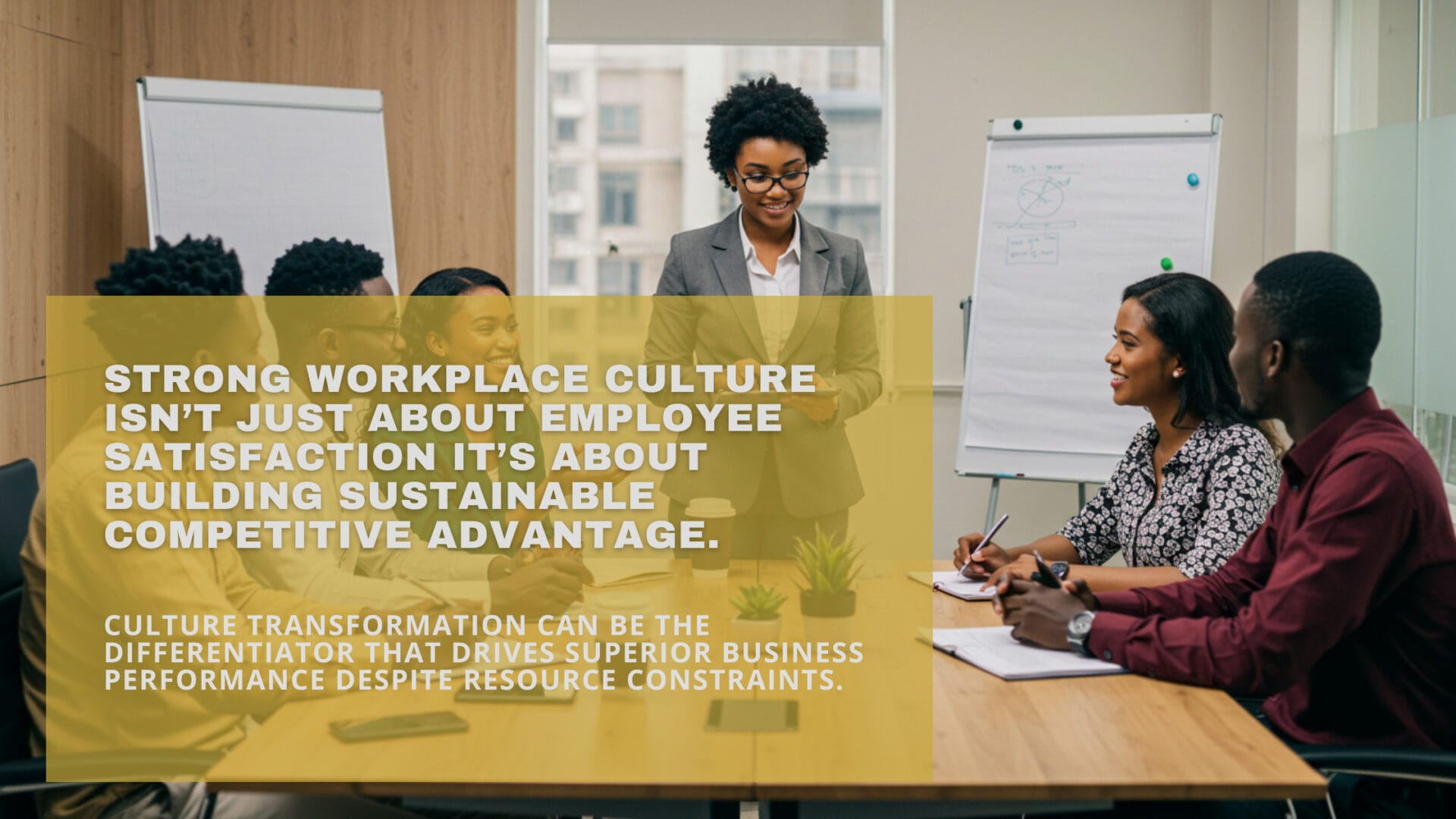
Strong workplace culture isn’t just about employee satisfaction it’s about building sustainable competitive advantage. Research shows that companies with engaged workforces are 23% more profitable and experience 18% higher productivity than competitors.
For Nigerian SMEs competing against larger corporations, culture transformation can be the differentiator that drives superior business performance despite resource constraints.
The Culture-Performance Connection in Nigerian SMEs
Employee engagement SME directly impacts business metrics:
- Revenue per employee increases 12-18% with strong culture
- Customer satisfaction improves as engaged employees provide better service
- Innovation rates rise when employees feel safe to share ideas
- Quality metrics improve through increased attention to detail
- Absenteeism drops by 25-35% in positive work environments
Culture Change #1: Shift from Blame to Problem-Solving
The Current State in Most SMEs
When problems occur, the first question is usually “Who did this?” rather than “How do we fix this?” This blame-focused approach creates fear, reduces innovation, and prevents learning from mistakes.
The Culture Transformation
Problem-solving culture focuses on understanding root causes and preventing future issues rather than punishing past mistakes.
Implementation Steps:
- Change meeting language: Ask “What happened?” before “Who was responsible?”
- Root cause analysis: Investigate systems and processes, not just individual actions
- Learning opportunities: Treat mistakes as chances to improve procedures
- Collective responsibility: Frame problems as team challenges to solve together
Business Impact: Companies adopting this approach see 40% fewer repeat errors and 60% more employee-generated improvement suggestions.
Culture Change #2: Create Psychological Safety
Why This Matters for SME Performance
Employees in psychologically safe environments are 67% more likely to report potential problems early, preventing costly mistakes and missed opportunities.
Building Safety in Nigerian Work Context
Psychological safety means employees can speak up, ask questions, and admit mistakes without fear of punishment or embarrassment.
Practical Implementation:
- Leader vulnerability: Management admits their own mistakes and learning areas
- Question encouragement: Reward employees who ask clarifying questions
- Idea protection: Never publicly criticize suggestions, even impractical ones
- Mistake response: Focus on learning and prevention, not blame
Cultural Indicators:
- Employees report problems quickly instead of hiding them
- Team meetings include genuine discussion and debate
- People ask questions without apologizing for “not knowing”
- Failed experiments are discussed openly for learning
Culture Change #3: Implement Regular Recognition Systems
Beyond Annual Bonuses
Most Nigerian SMEs limit recognition to yearly bonuses or promotions. High-performance cultures recognize contributions weekly or monthly through multiple channels.
Recognition That Drives Performance
Effective employee recognition acknowledges different types of value creation:
Performance Recognition:
- Monthly awards for exceptional results with specific metrics
- Public acknowledgment of goal achievement and milestone completion
- Peer nomination systems for outstanding collaboration
Innovation Recognition:
- “Bright Idea” awards for process improvements and cost-saving suggestions
- Implementation bonuses when employee suggestions are adopted
- Innovation showcase sessions where creators present their solutions
Values Recognition:
- “Culture Champion” acknowledgments for behavior that exemplifies company values
- Team spotlights for exceptional customer service or colleague support
- Leadership recognition when employees mentor or develop others
Implementation Framework:
- Weekly: Verbal recognition in team meetings
- Monthly: Written recognition with specific achievement details
- Quarterly: Formal awards with modest financial recognition
- Annually: Major performance bonuses and advancement opportunities
Culture Change #4: Establish Clear Values (And Live Them)
The Values Gap in Nigerian SME
Many companies have stated values bsut don’t integrate them into daily decision-making. Strong workplace culture requires values that guide actual behavior, not just marketing materials.
Creating Operational Values
Effective organizational values should be:
- Specific enough to guide decisions (not generic statements)
- Actionable in daily work situations
- Measurable through observable behaviors
- Relevant to your industry and customer base
Values Implementation Process:
Step 1: Define Behavioral Values Instead of “Integrity,” specify “We keep commitments to customers and colleagues, even when it’s difficult.”
Step 2: Decision Integration Use values as filters for hiring, promotion, project prioritization, and policy development.
Step 3: Accountability Systems Include values demonstration in performance reviews and recognition criteria.
Step 4: Leadership Modeling Management decisions should visibly reflect stated values, especially during challenging situations.
Culture Change #5: Build Learning Culture
Continuous Improvement Mindset
Learning culture treats skill development and process improvement as ongoing responsibilities, not occasional training events.
Learning Infrastructure for SMEs
Formal Learning:
- Monthly skills workshops (2 hours per session)
- Conference attendance rotation (different employees each quarter)
- Online certification support with company-sponsored programs
- Cross-training initiatives to develop versatile team members
Informal Learning:
- “Lunch and Learn” sessions where team members share expertise
- Industry article sharing and discussion groups
- Customer feedback review sessions for service improvement
- Process improvement brainstorming meetings
Knowledge Sharing:
- Document best practices and lessons learned from projects
- Create internal knowledge base accessible to all team members
- Establish mentoring relationships between experienced and newer employees
- Regular “what we learned” discussions after completing major projects
Business Benefits:
- Adaptability: Teams respond faster to market changes and customer needs
- Innovation: Continuous learning drives creative problem-solving
- Engagement: Development opportunities increase job satisfaction and retention
- Capability: Broader skill base enables business growth and expansion
Culture Change #6: Foster Open Communication
Breaking Down Communication Barriers
Many Nigerian SMEs operate with hierarchical communication patterns that slow decision-making and hide important information from leadership.
Open Communication Systems
Information Transparency:
- Monthly business performance sharing with all employees
- Strategic decision explanation with reasoning and expected outcomes
- Market condition updates and their impact on company direction
- Financial health communication (appropriate level of detail for team size)
Feedback Mechanisms:
- Upward feedback: Regular opportunities for employees to provide input to management
- Peer feedback: Structured systems for collaborative improvement
- Customer feedback: Shared insights from client interactions and market response
- Anonymous channels: Safe ways to report concerns or suggest improvements
Decision Involvement:
- Include frontline employees in operational improvement discussions
- Seek input on customer experience and service delivery enhancement
- Involve team members in workflow and process optimization
- Create cross-functional project teams for major initiatives
Communication Training:
- Listening skills development for managers and team leaders
- Conflict resolution techniques for addressing disagreements constructively
- Presentation skills to help employees communicate ideas effectively
- Cultural sensitivity training for diverse team environments
Implementation Timeline for Culture Transformation
Month 1: Foundation Setting
- Week 1-2: Assess current culture through employee surveys and observation
- Week 3: Define target culture characteristics and values
- Week 4: Communicate culture transformation goals and obtain leadership commitment
Month 2: System Implementation
- Week 1: Launch recognition systems and feedback mechanisms
- Week 2: Implement problem-solving approaches and safety initiatives
- Week 3: Begin learning programs and communication improvements
- Week 4: Train managers on new culture practices and expectations
Month 3: Reinforcement and Adjustment
- Week 1-2: Gather feedback on culture initiatives and make necessary adjustments
- Week 3: Expand successful programs and modify less effective approaches
- Week 4: Plan long-term culture sustainment and continuous improvement
Measuring Culture Transformation Success
Leading Indicators (Month 1-3):
- Participation rates in new culture programs and initiatives
- Feedback frequency through surveys, suggestions, and open communication
- Recognition activity levels and peer nomination participation
- Learning engagement in training programs and development opportunities
Performance Indicators (Month 3-6):
- Employee satisfaction scores through quarterly culture surveys
- Retention improvement measured by reduced voluntary turnover
- Productivity metrics including output per employee and quality measures
- Innovation activity tracked through improvement suggestions and implementations
Business Impact Indicators (Month 6-12):
- Customer satisfaction improvements linked to better employee engagement
- Revenue per employee growth as productivity and effectiveness increase
- Market responsiveness measured by faster adaptation to customer needs and market changes
- Competitive advantage demonstrated through talent attraction and business performance
When Culture Transformation Requires Professional Support
Complex culture change often benefits from external expertise when dealing with:
- Resistance from middle management who may feel threatened by new approaches
- Family business dynamics that complicate traditional management structures
- Rapid growth requiring culture scaling across multiple locations or departments
- Previous failed attempts at culture change that created cynicism or resistance
- Integration challenges when merging teams or acquiring other businesses
Professional culture consulting accelerates transformation by providing:
- Objective assessment of current culture strengths and improvement areas
- Change management expertise for minimizing disruption during transition
- Proven frameworks for sustainable culture development and measurement
- Leadership coaching to help managers adapt to new culture expectations
ROI of Workplace Culture Investment
Typical Investment Requirements:
- Assessment and planning: 1-2% of annual revenue for comprehensive culture audit
- Implementation support: 2-3% of annual revenue for first-year transformation
- Ongoing sustainment: 1% of annual revenue for culture maintenance and improvement
Expected Returns:
- Productivity gains: 15-25% improvement in output per employee
- Retention savings: 40-60% reduction in turnover-related costs
- Customer satisfaction: 20-30% improvement in service delivery metrics
- Innovation increase: 50-75% more employee-generated improvement ideas
Payback Timeline:
Most Nigerian SMEs see positive ROI from culture transformation within 12-18 months, with benefits accelerating in years 2-3 as new practices become deeply embedded.
6-Step Culture Transformation Action Plan
Step 1: Assess your current workplace culture using employee surveys and observation
Step 2: Define target culture characteristics aligned with business goals
Step 3: Implement 2-3 culture changes from the framework above
Step 4: Train leadership team on new culture practices and expectations
Step 5: Launch measurement systems to track culture and performance improvements
Step 6: Plan ongoing sustainment through regular review and adjustment
Ready to Transform Your Workplace Culture?
Culture transformation isn’t a one-time project it’s an ongoing investment in your company’s competitive advantage. Start with our 6-step action plan above, or contact Efficentra for a comprehensive culture assessment designed specifically for Nigerian SMEs.
Strong workplace culture Nigeria drives measurable business results. The question is: Will you use culture as a competitive advantage, or let weak culture limit your growth potential?
Related Articles:
- 7 Employee Retention Strategies for Nigerian SMEs
- Building High-Performance Teams
- Leadership Development for Growing Companies

About the Author
Helen Solange Inengite is the Principal Consultant at Efficentra, serving as a strategic partner to Nigerian SMEs in building high-performance teams and driving sustainable growth. With over 16 years in HR and business strategy, she is also a certified happiness coach passionate about employee well-being